

The Kremlin is working to suppress memorials for the late opposition figure Alexei Navalny in a bid to prevent his death from spoiling President Vladimir Putin’s expected re-election next month.
Authorities are using harsh detentions of Navalny’s grieving supporters and censorship to prevent acts of mourning from turning into political protests, sources in the Russian government, parliament and close to the Kremlin told The Moscow Times.
"The presidential administration and Federal Security Service officials discussed a plan on how to prevent the spread of a public campaign in support of Navalny," a Russian government official told The Moscow Times.
Like the other sources interviewed for this article, the official spoke on condition of anonymity since he is not allowed to discuss his work with the press.
With Russia’s presidential election quickly approaching, the authorities are determined to stamp out any public unrest that could overshadow the vote or push voters away from Putin.
“One of the problems discussed was how to make sure Navalny's mourning and funeral do not turn into a political demonstration and spoil the election for Putin,” a source close to the Kremlin said. “Various options have been proposed, down to the very cynical one of not releasing the body to his relatives until after the election.”
"We have a presidential election coming up. We don't need this because it will be a problem for the boss [Putin]," a Russian government official told The Moscow Times.
The official said that the authorities were even weighing the option of never releasing Navalny’s body, adding that there have already been “many precedents like that over the years.”
Authorities could state that the person was jailed for a terrorist offense or is at risk of spreading a dangerous disease as justification for withholding the body from relatives, for example.
“But in Navalny's case, of course, that would be unprecedented,” the official said.
On Monday, investigators told Navalny’s mother and lawyers that they would not release his body for at least another 14 days in order to carry out a “chemical examination.”
In the three days since Navalny, Putin’s most vocal critic over the past decade, died in an Arctic penal colony, his supporters and sympathizers have paid tribute with makeshift memorials in nearly 200 cities and towns across Russia.
Authorities have responded by dismantling the memorials and detaining almost 400 mourners, sometimes violently.
At the same time, they appear to be working to stop Russians from leaving expressions of their grief online.
Users of the popular 2GIS map platform have reportedly been blocked from leaving comments on monuments to victims of political repression on its maps. Russians have used this feature to voice dissent amid a near-total ban on protests and media censorship in recent years.
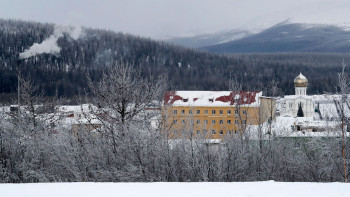
The penal colony and morgue in the polar Yamal-Nenets autonomous district have refused to grant Navalny's family and lawyers access to his body or even disclose its whereabouts.
According to the independent news website Mediazona, which obtained traffic camera footage from the town where Navalny was being held in prison, his body was likely taken to an unknown location just before his mother and lawyers arrived to see it.