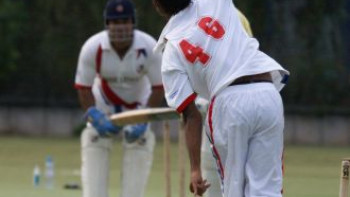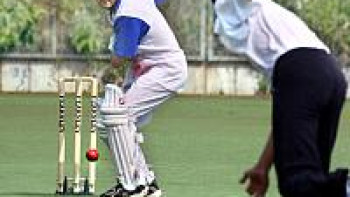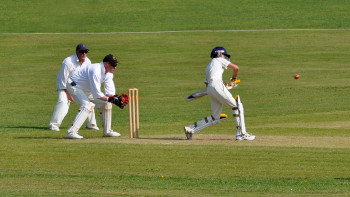


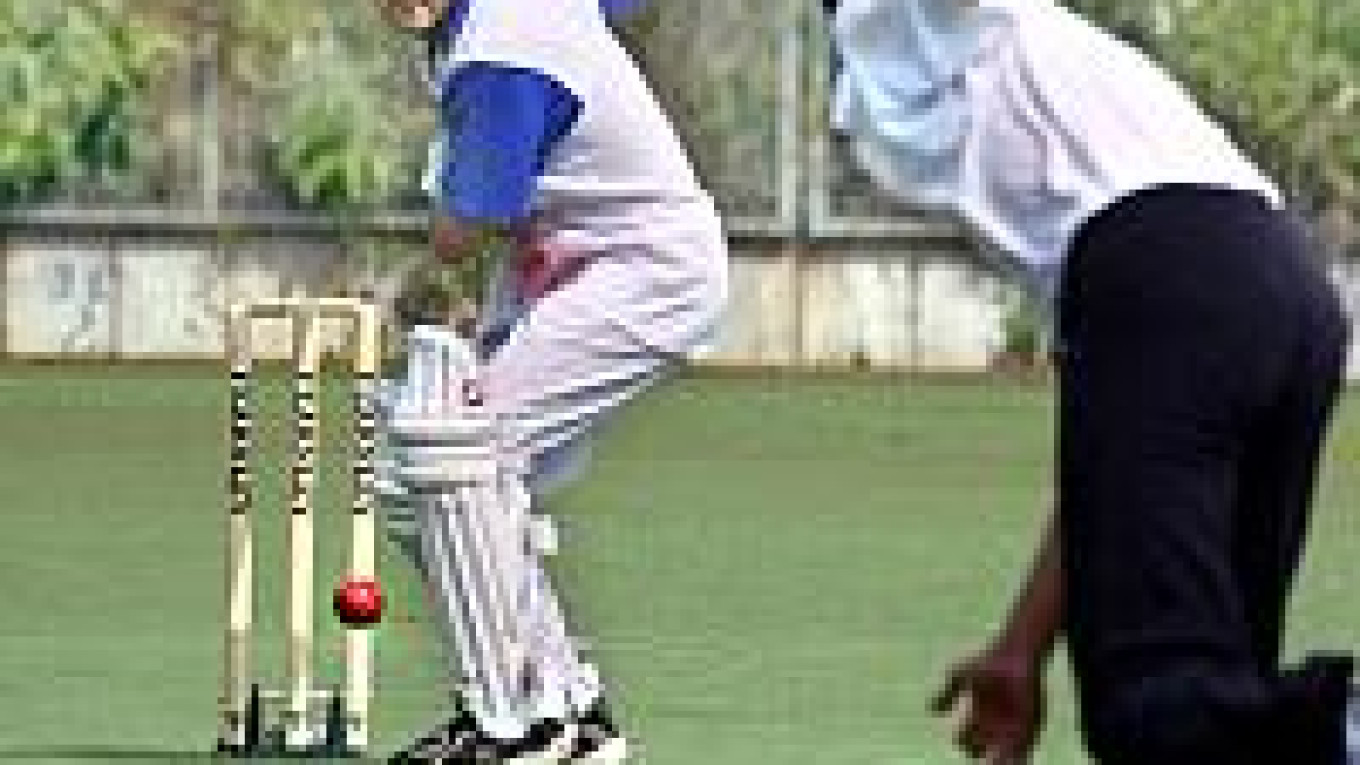
If you want a game of cricket but you don't have the proper equipment, all you need to do is wrap a tennis ball in electrical tape, and get hold of a chair for wickets and something that passes for a bat. At least that's how Moscow's expat cricketers first played when they started out.
"We had all played active sports in our home countries, so we started similar sporting activities here," said Vineet Arora, one of the founders of Moscow's first cricket club. "But because of a lack of facilities and equipment, we had to play in small courtyards or any other available spaces."
Throughout the 1990s, when cricket-playing expat colonies began emerging, the custom was for the British and Australians to play among themselves, and likewise the Indians, Pakistanis, Bangladeshis and Sri Lankans. In 2000, a more organized cricket league was set up, bringing together four teams -- Australia, England, India and a World XI.
"By that time we had managed to get in some kit. We had proper balls and proper gear, and we were playing a proper tournament," Arora said.
By the second year, it was decided that, for the sake of a more communal approach, the country squads would be dissolved in favor of a club-based competition.
"We felt that this would get more people together and get rid of this ethnic divide," Arora said.
While the cricket community has endeavored, as much as possible, to avoid the game remaining a minority interest, it is a valuable social event for bringing together the city's Indians and Pakistanis. In July, a Pakistan vs. India one-day match was played and attended by Pakistan's ambassador to Russia, who also participated in the awards ceremony.
"If anybody knows anything about India, then it's that we absolutely love cricket," said Sanjay Tewary, captain of Friends, this year's Moscow cricket league runner-up. "So it's a perfect opportunity for our community to get together. Also, most importantly, it's fun."
But the greatest difficulty when trying to get a cricket game started is finding a suitable playing field, especially in a country with no history of the sport.
In Moscow, the only fields available were ones with synthetic surfaces. Eventually, a suitable site was located on the grounds of Moscow State University: a baseball field. Even having found the right location, however, difficulties remain.
"Timing and the amount of money you spend hiring the ground, these all play their part," Arora said. "Of course, we can only play for three months, maybe four if the weather is good. We can only play on weekends, so that makes for roughly 32 days in which you can play. Even then, the field is not always available for you to play all the time."
The future goal is to expand the game so that it becomes more than just a weekend get-together for foreigners. It was this idea that drove the Moscow cricket club to contact the European Cricket Council.
"The ECC told us that they were very interested in seeing cricket expand in non-cricket-playing countries and said they were happy to see Russia included among its members." Arora said.
This next step toward establishing itself as an official organization required the club to register under the name of the United Cricket League. Any mention of "Russia" or "Moscow" in the title of the association would have involved further bureaucratic hassles, so the decision was made to omit both.
Once the ECC became involved, more attention began to be paid toward the practicalities of popularizing cricket in the city.
"A big setback is the weather," Arora said. "Cricket is played outdoors, so you can't play when it's raining or snowing, which means we can only really play in summer. But what we can do to change the situation is to find indoor venues. When we find these places, we can start getting kids involved."
"The ECC is very keen on getting coaches sent out for two to three months at a time. When we get the school kids involved, there is a good chance for the local population to get more involved in the sport. And that is one way in which the sport can increase its profile in the country."
Indeed, profile is a key question in a country where cricket is virtually unknown, or even sometimes mistaken for baseball. When Russian spectators show up to watch, players often have to field questions about the most basic aspects of the game.
"People want to hold the bat to see how it feels, they want to hold the ball, to know what the ball is made of and if it hurts if you get hit by it and so on," said Mohanjit Singh, another founder of the United Cricket League.
But the league's founders acknowledge that the international backing they have received is just the start, and a lot of work remains to be done to popularize the game at a grassroots level.